 Call Us : 08071931506Call Us : 08071931506

 Send Inquiry
Metravi DDS-1060 DDS Function Generator
Price 61301.00 INR/ Piece
MOQ : 1 Piece
Metravi DDS-1060 DDS Function Generator Specification
- Mounting Type
- Bench-top
- Power Supply
- AC 220V 10% 50Hz
- Measuring Range
- 1 Hz 60 MHz
- Accuracy
- 2 ppm
- Interface Type
- USB
- Operating Voltage
- AC 220V / 110V (switchable)
- Features
- Frequency counter, sweep function, AM/FM modulation, arbitrary waveform, digital storage, dual channel
- Equipment Type
- DDS Function Generator
- Test Range
- 1 Hz - 60 MHz
- Humidity
- 0 - 80% RH, non-condensing
- Resolution
- 1 Hz
- Automation Grade
- Manual
- Frequency
- 1 Hz 60 MHz
- Temperature
- 0C to 40C
- Display Type
- Large LCD display
- Application
- Signal generation, testing, laboratory and R&D
- Usage
- Electronic test and measurement
- Machine Weight
- 2 kg
- Control Mode
- Manual / Digital
- Output Impedance
- 50
- Output Amplitude
- 0-10Vpp (50 load, adjustable)
- Frequency Counter
- 1Hz to 100MHz
- Power Consumption
- <20W
- Modulation Function
- AM, FM, FSK, Sweep
- Output Waveforms
- Sine, Square, Triangle, TTL, Pulse, Ramp, Arbitrary
- Dimensions
- 295 220 90 mm
- Output Channels
- Single channel
- Arbitrary Waveform Length
- 2048 points
- THD (Sine Wave)
- <0.08% (1kHz)
- Memory
- 20 sets for user-defined waveforms
Metravi DDS-1060 DDS Function Generator Trade Information
- Minimum Order Quantity
- 1 Piece
- Payment Terms
- Cash Advance (CA), Cash in Advance (CID), Cheque
- Supply Ability
- 100 Pieces Per Week
About Metravi DDS-1060 DDS Function Generator
- 60 MHz sinewave out, down to 1Hz resolution for full frequency range.
- 25 MHz pulse waveform with adjustable rise & fall time and duty cycle.
- 250MSa/s sample rate and 14-bit vertical rsolution.
- 6-digit high percision meter that is compatible with TTL level signal
- Standard dual channels with independent output mode
- 1M arbitrary wave form memory and 48 waveforms non-volatile storage.
- Multiple modulation types : AM, FM, PM, ASK, FSK, PSK, PWM.
- Powerful software available to use in PC.
- 4.3 inch high-resolution TFT color display
- Standard Interfaces : USB Host, USB Device, optinal Lan.
- Dual channels can be applied at the same time or independently : internal/external modulation, internal/external.manual trigger.
- Support frequency sweep and burst output
- Ease-of-use multipurpose knob and numeric keypad
Versatile Waveform Generation
The Metravi DDS-1060 offers a comprehensive range of output waveforms including sine, square, triangle, ramp, pulse, TTL, and user-defined arbitrary shapes. With adjustable amplitude and frequencies spanning from 1 Hz to 60 MHz, users can generate precise test signals for various electronic experiments, diagnostics, and research tasks.
Advanced Modulation and Sweep Functions
Take advantage of advanced signal modulation features such as AM, FM, FSK, and frequency sweep. These functions enhance the DDS-1060s capability for simulating real-world signals and performing thorough system tests. Its ideal for both routine measurements and sophisticated laboratory or R&D investigations.
User-Friendly Design and Connectivity
Equipped with a large LCD display and intuitive manual or digital controls, the DDS-1060 ensures effortless operation. The unit includes USB interface for waveform storage and retrieval, fits securely on any bench-top, and operates on standard AC voltages with low power consumption, making it a practical choice for professional test environments.
FAQs of Metravi DDS-1060 DDS Function Generator:
Q: How does the Metravi DDS-1060 function generator benefit laboratory signal testing?
A: The DDS-1060 provides a wide frequency range, multiple waveform outputs, and precise modulation options like AM, FM, and sweep. This versatility allows laboratories to simulate, test, and analyze a variety of electronic circuits, improving the accuracy and reliability of test results.Q: What output waveforms can I generate with this function generator?
A: You can generate sine, square, triangle, pulse, ramp, TTL, and arbitrary waveforms. The arbitrary function supports user-defined shapes up to 2048 points, enabling custom signal generation for specialized applications.Q: When should I use the frequency counter feature?
A: Utilize the built-in frequency counter (1 Hz to 100 MHz) for accurately measuring external signal frequencies during experiments, system diagnostics, or calibration procedures where verifying exact frequencies is essential.Q: Where is the Metravi DDS-1060 best suited for use?
A: This generator is ideal for electronic laboratories, R&D departments, educational institutes, and production test environments. Its bench-top design and robust feature set make it suitable for professional and academic settings across India.Q: What is the process for creating and storing an arbitrary waveform?
A: To create an arbitrary waveform, use the digital interface or USB connectivity to design your waveform. The DDS-1060 allows storage of up to 20 user-defined waveform sets with a maximum of 2048 points each, accessible at any time for testing or simulation.Q: How does the adjustable output amplitude and impedance enhance testing?
A: With output amplitude adjustable up to 10 Vpp (on 50 load) and a standard 50 output impedance, users can closely match the generator to their test circuits requirements, minimizing distortion and ensuring accuracy in measurement and analysis.Q: What advantages does the large LCD display offer?
A: The large LCD display provides clear, real-time information on waveform parameters, settings, and measurement data, making it easier to operate, monitor, and quickly adjust test configurations.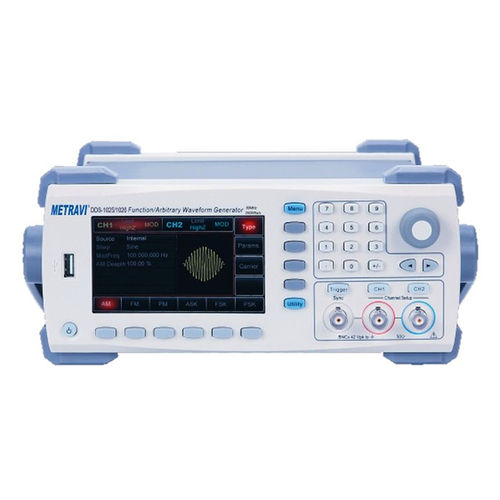
Tell us about your requirement

Price:
Quantity
Select Unit
- 50
- 100
- 200
- 250
- 500
- 1000+
Additional detail
Mobile number
Email

More Products in Digital Function Generator Category
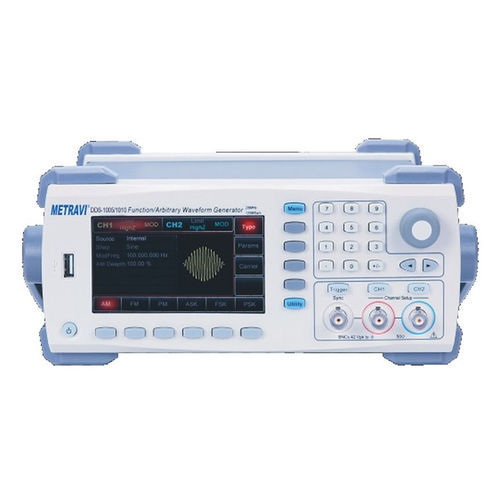
Metravi DDS-1010 DDS Function Generator
Price 22892.00 INR / Piece
Minimum Order Quantity : 1 Piece
Application : Signal generation for testing, education, and R&D
Mounting Type : Benchtop
Power Supply : 220V AC 10%, 50Hz
Measuring Range : 0.1 Hz 10 MHz
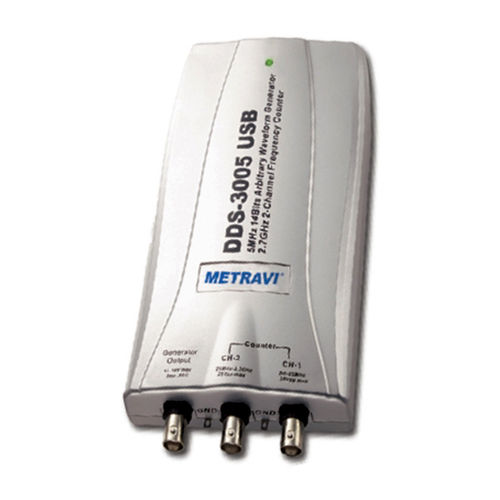
Metravi DDS-3005 PC Based Arbitrary Function Generator & Frequency Counter
Price 54457.00 INR / Piece
Minimum Order Quantity : 1 Piece
Application : Test Signal Generation, Educational Labs, R&D, Electronics Testing
Mounting Type : Desktop
Power Supply : 5V DC via USB
Measuring Range : Frequency Counter: 1Hz50MHz
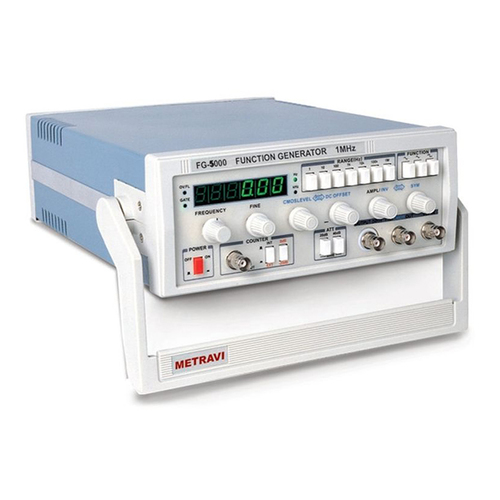
Metravi FG-5000 Digital Waveform Generator
Price 15517.00 INR / Piece
Minimum Order Quantity : 1 Piece
Application : Signal generation, function generator, waveform testing
Mounting Type : Tabletop/Desktop
Power Supply : DC 5V, 2A (via USB)
Measuring Range : Sine, Square, Triangle, Pulse, Sawtooth, Arbitrary waveforms
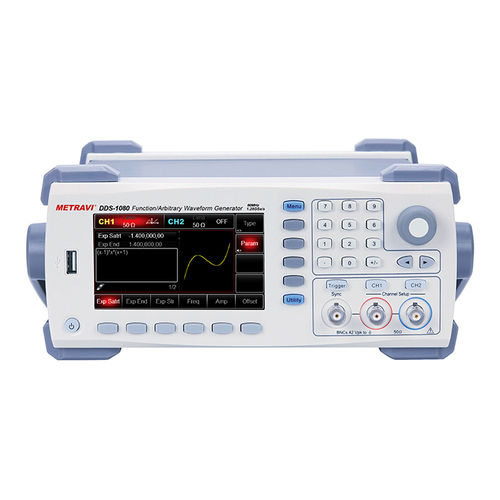
DDS-1080 DDS Function Generator
Price 76877.00 INR / Piece
Minimum Order Quantity : 1 Piece
Application : Electronic circuit testing, research, development, training
Mounting Type : Benchtop
Power Supply : 220V AC 10%, 50Hz
Measuring Range : 0.01 Hz to 10 MHz

Address
METRAVI INSTRUMENTS PVT. LTD.
GST : 19AAGCM1428H1ZH
GST : 19AAGCM1428H1ZH
- 32A, Ganesh Chandra Avenue, 4th Floor,Kolkata - 700013, West Bengal, India
- Phone :08071931506
- Send Inquiry
 Send Inquiry
 Send Inquiry
 Send SMS
 |
METRAVI INSTRUMENTS PVT. LTD.
All Rights Reserved.(Terms of Use) Developed and Managed by Infocom Network Private Limited. |
