 Call Us : 08071931506Call Us : 08071931506

 Send Inquiry
Metravi DDS-3005 PC Based Arbitrary Function Generator & Frequency Counter
Price 54457.00 INR/ Piece
MOQ : 1 Piece
Metravi DDS-3005 PC Based Arbitrary Function Generator & Frequency Counter Specification
- Operating Voltage
- USB Powered 5V
- Application
- Test Signal Generation, Educational Labs, R&D, Electronics Testing
- Port Size
- USB 2.0
- Humidity
- 85% RH (Non-Condensing)
- Resolution
- 1Hz
- Features
- Arbitrary Waveform, Direct Digital Synthesis (DDS), PC Software
- Test Range
- Sine: 1Hz5MHz
- Interface Type
- USB 2.0
- Temperature
- 040C
- Display Type
- Digital (PC Screen)
- Mounting Type
- Desktop
- Equipment Type
- Arbitrary Function Generator & Frequency Counter
- Accuracy
- 10ppm
- Automation Grade
- Automatic/PC Controlled
- Power Supply
- 5V DC via USB
- Frequency
- 5MHz (Output), Up to 50MHz (Counter)
- Measuring Range
- Frequency Counter: 1Hz50MHz
- Usage
- Electronic Test and Measurement
- Machine Weight
- Approx. 500g
- Control Mode
- PC-Based Control
- Cooling
- Passive cooling
- Frequency Counter Range
- 0.1 Hz 50 MHz
- PC Software
- Custom Windows application included
- Sampling Rate
- Up to 25 MSa/s
- Safety
- Over-voltage and overload protection
- Data Transfer Rate
- High-speed USB communication
- Waveform Types
- Sine, Square, Triangle, Pulse (PWM), Arbitrary
- Amplitude Range
- 0~10 Vpp
- Operating System Support
- Windows XP/7/8/10
- Signal Integrity
- Low distortion, high stability
- Dimension
- 220 x 140 x 45 mm (W x D x H)
- Output Impedance
- 50
- Memory Depth
- 4 Kpts (waveform storage)
Metravi DDS-3005 PC Based Arbitrary Function Generator & Frequency Counter Trade Information
- Minimum Order Quantity
- 1 Piece
- Payment Terms
- Cash in Advance (CID), Cheque, Cash Advance (CA)
- Supply Ability
- 100 Pieces Per Week
About Metravi DDS-3005 PC Based Arbitrary Function Generator & Frequency Counter
- Two Channel Digital Storage Oscilloscope
- When connected to PC with USB 2.0 Interface, provides fully featured Digital Storage Oscilloscope
- Provides extra advantage of easily storing data for future use
- Has two independent channels.
- The program screen emulates a conventional oscilloscope
- The Auto Set function adjusts the settings automatically to the current signal, and the extensive trigger functions make it very simple to operate
- The expanded spectrum analyzer windows including the FFT analysis and the multi-kinds of measurements are more powerful tools in data analysis
- Press a button to transfer the on-screen data to an Excel file for further processing and the waveform can be recalled as a reference for comparison with the new one
- Bandwidth: 100MHz
- Channels: Two + external triggering
- Sampling Rate: 250MS/sec
- Memory: 1MB
- Resolution 8bit
- Plug & Play Device
Advanced Test Signal Generation
Harness the power of Direct Digital Synthesis (DDS) for generating high-precision waveforms, including sine, square, triangle, pulse, and customizable arbitrary signals. With amplitude settings from 0 to 10 Vpp and outstanding resolution, the DDS-3005 accommodates a wide array of testing and development needs in electronics.
User-Friendly PC-Based Operation
Control the DDS-3005 entirely from your Windows PC using the included custom software. Easily configure waveforms, monitor signals, and utilize the digital display on your screen for quick data visualization and analysis. High-speed USB connectivity ensures seamless data transfer and operation.
Robust Measurement and Safety
In addition to function generation, the DDS-3005 features a frequency counter ranging from 0.1 Hz to 50 MHz with 10ppm accuracy, making it ideal for precise measurements. Over-voltage and overload protections safeguard your device, ensuring consistent reliability and safety during operation.
FAQs of Metravi DDS-3005 PC Based Arbitrary Function Generator & Frequency Counter:
Q: How is the Metravi DDS-3005 operated and controlled?
A: The DDS-3005 operates exclusively through a custom Windows application, allowing users to manage and monitor all functions from a PC via a USB 2.0 connection. This offers a user-friendly interface and streamlined workflow for test and measurement tasks.Q: What types of waveforms can this function generator produce?
A: The device supports multiple waveform outputs, including sine, square, triangle, pulse (PWM), and arbitrary waveforms. Users can easily select and configure these signals using the provided PC software.Q: Where can the DDS-3005 be effectively used?
A: The DDS-3005 is well-suited for electronics testing, research and development, educational labs, and general signal measurement applications. Its compact size and desktop mounting make it convenient for laboratory benches and workstations.Q: What is the process for storing custom waveforms?
A: Custom waveforms can be generated and loaded into the device using the included software. With a memory depth of 4 Kpts, the DDS-3005 allows users to store and recall complex arbitrary waveforms for repeated testing or analysis.Q: When is the frequency counter feature most beneficial?
A: The integrated frequency counter is especially useful during tasks requiring precise frequency measurement, such as circuit debugging, quality control, or verifying output frequencies in test setups. It operates in the range of 0.1 Hz to 50 MHz.Q: What are the advantages of using a USB-powered, PC-based signal generator?
A: A USB-powered, PC-based system offers flexibility, portability, and reduced workspace clutter while maintaining robust performance. It ensures compatibility with standard Windows operating systems and eliminates the need for bulky external power supplies.Q: How does the device ensure signal integrity and safety during use?
A: The DDS-3005 is engineered for low distortion and high stability, providing accurate and clean signals. It includes over-voltage and overload protection mechanisms to safeguard both the unit and connected devices during operation.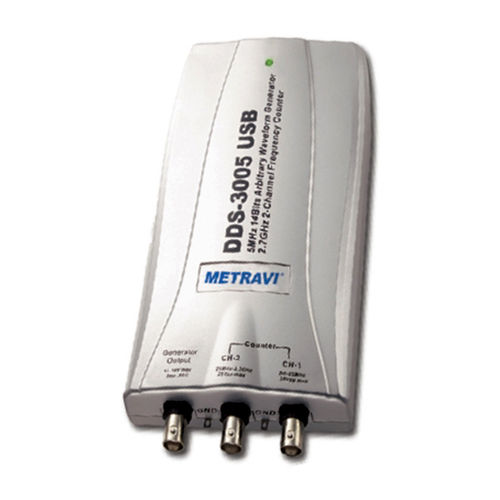
Tell us about your requirement

Price:
Quantity
Select Unit
- 50
- 100
- 200
- 250
- 500
- 1000+
Additional detail
Mobile number
Email

More Products in Digital Function Generator Category
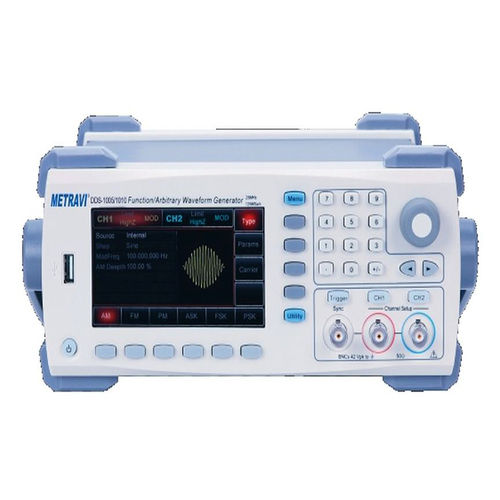
Metravi DDS-1005 DDS Function Generator
Price 20709.00 INR / Piece
Minimum Order Quantity : 1 Piece
Equipment Type : DDS Function Generator
Accuracy : Frequency: 20 ppm
Interface Type : BNC, USB
Usage : Electronic Testing & Measurement
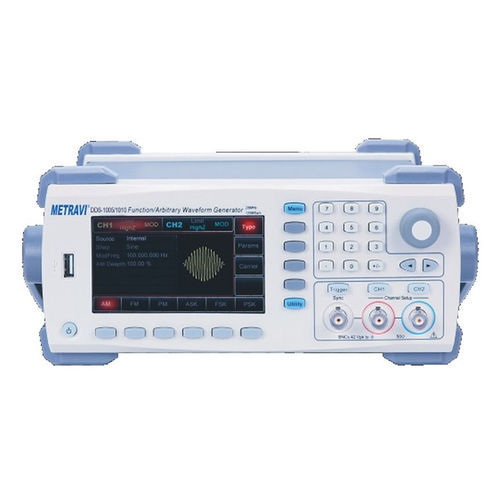
Metravi DDS-1010 DDS Function Generator
Price 22892.00 INR / Piece
Minimum Order Quantity : 1 Piece
Equipment Type : Digital DDS Function Generator
Accuracy : 10 ppm
Interface Type : BNC output
Usage : Laboratory, educational, test & measurement
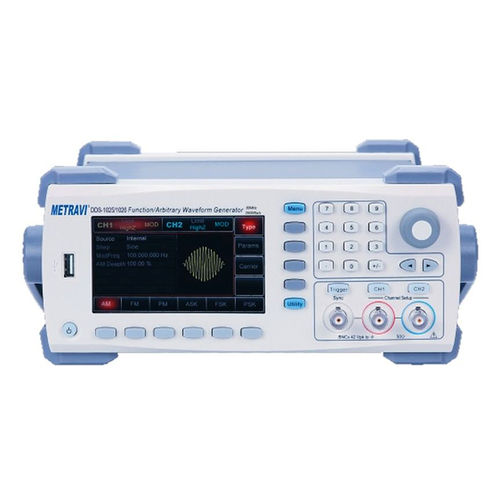
Metravi DDS-1025 DDS Function Generator
Price 42657.00 INR / Piece
Minimum Order Quantity : 1 Piece
Equipment Type : DDS Function Generator
Accuracy : 10 ppm
Interface Type : BNC Output
Usage : Laboratory, field testing, R&D
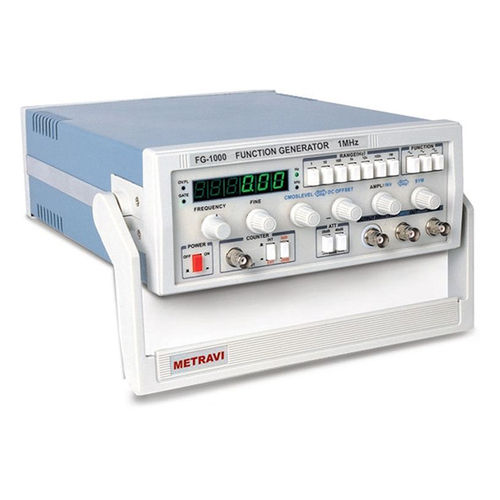
Metravi FG-1000 Digital Function Generator
Price 12567.00 INR / Piece
Minimum Order Quantity : 1 Piece
Equipment Type : Digital Function Generator
Accuracy : 1% of output frequency
Interface Type : BNC Output
Usage : Laboratory, R&D, educational institutes

Address
METRAVI INSTRUMENTS PVT. LTD.
GST : 19AAGCM1428H1ZH
GST : 19AAGCM1428H1ZH
- 32A, Ganesh Chandra Avenue, 4th Floor,Kolkata - 700013, West Bengal, India
- Phone :08071931506
- Send Inquiry
 Send Inquiry
 Send Inquiry
 Send SMS
 |
METRAVI INSTRUMENTS PVT. LTD.
All Rights Reserved.(Terms of Use) Developed and Managed by Infocom Network Private Limited. |
