 Call Us : 08071931506Call Us : 08071931506

 Send Inquiry
Metravi DDS-1120 DDS Function Generator
Price 89857 INR/ Piece
MOQ : 1 Piece
Metravi DDS-1120 DDS Function Generator Specification
- Measuring Range
- 0.01 Hz to 20 MHz
- Operating Voltage
- AC 220V 10%, 50Hz
- Interface Type
- USB Host & Device, RS232
- Test Range
- 0.01 Hz - 20 MHz
- Mounting Type
- Tabletop
- Humidity
- 80% RH (non-condensing)
- Display Type
- 2.4 TFT LCD Display
- Power Supply
- AC 220V 10%, 50Hz
- Temperature
- 0C to 40C
- Accuracy
- 1010 (frequency)
- Automation Grade
- Manual
- Application
- Function/Signal generation for testing and measurement
- Resolution
- 10 mHz
- Features
- Waveform Output, Digital Display, Sweep Function, Frequency Counting, Arbitrary Waveform Function
- Frequency
- 0.01 Hz - 20 MHz
- Usage
- Laboratory, R&D, Education, Electronic Equipment Testing
- Machine Weight
- 1.6 kg
- Control Mode
- Manual
- Frequency Counter
- 1 Hz - 100 MHz
- Sweep Mode
- Linear or Logarithmic
- Equipment Type
- DDS Function Generator
- Arbitrary Waveform Memory
- 2 Kpts
- Main Waveforms
- Sine, Square, Triangle, Pulse, Arbitrary, Ramp, Noise
- Phase Adjustment
- 0 to 360
- Maximum Output Voltage
- 20 Vpp (open-circuit)
- Display Resolution
- 320 x 240 pixels
- Modulation Functions
- AM, FM, FSK
- Dimensions
- 220 mm 200 mm 65 mm
- Model
- DDS-1120
- Output Impedance
- 50 10%
- Duty Cycle
- 1% ~ 99% (available for square and pulse)
Metravi DDS-1120 DDS Function Generator Trade Information
- Minimum Order Quantity
- 1 Piece
- Payment Terms
- Cash in Advance (CID), Cheque, Cash Advance (CA)
- Supply Ability
- 100 Pieces Per Week
About Metravi DDS-1120 DDS Function Generator
- 1Hz full-band resolution
- 5MHz~30MHz pulse waveform, adjustable rise/fall time
- 14-bit/16-bit vertical resolution
- Two equivalent-performance channels
- Max arbitrary waveform length of 8k/16M points; 48/161
- non-volatile waveforms storage
Comprehensive Waveform Generation
With the Metravi DDS-1120, users can easily produce sine, square, triangle, pulse, noise, ramp, and arbitrary waveforms, tailored for various test scenarios. The output voltage can go up to 20 Vpp (open-circuit), while the duty cycle is adjustable from 1% to 99% for square and pulse outputs, ensuring adaptability to diverse application needs.
Advanced Modulation and Sweep Functions
The DDS-1120 supports AM, FM, and FSK modulation, as well as linear and logarithmic sweep modes-making it suitable for in-depth analysis and complex signal simulation. Arbitrary waveform functionality, with 2 Kpts memory, enables users to generate custom signal shapes needed for challenging test cases.
User-Friendly Interface and Connectivity
A 2.4-inch TFT LCD with 320 x 240 resolution provides clear visual feedback. The equipment is controlled manually and comes equipped with USB Host & Device, along with RS232 interfaces, allowing integration with test systems and PCs for data transfer or remote operation.
Reliable Performance in Laboratory Settings
Engineered for laboratory, R&D, and educational applications, the DDS-1120 maintains measurement accuracy of 10106, 10 mHz resolution, and stable operation across 0C-40C and up to 80% non-condensing humidity. It is compact, lightweight (1.6 kg), and powered by AC 220V 10%, 50 Hz, adapting seamlessly to standard lab environments.
FAQ's of Metravi DDS-1120 DDS Function Generator:
Q: How do I generate a specific waveform on the Metravi DDS-1120?
A: Select the desired waveform (sine, square, triangle, pulse, arbitrary, ramp, or noise) using the manual control interface. Adjust parameters such as frequency, amplitude (up to 20 Vpp), and duty cycle (for square or pulse) directly from the front panel to suit your testing requirements.Q: What are the main benefits of using this function generator for electronic testing?
A: The DDS-1120 delivers precise signal generation with high resolution (10 mHz), broad frequency range (0.01 Hz to 20 MHz), and versatility across multiple waveforms and modulation types. Its arbitrary waveform capability and memory allow for simulation of real-world signal conditions, making it invaluable for troubleshooting, development, and education.Q: Where is the Metravi DDS-1120 typically used?
A: This function generator is widely used in laboratories, R&D facilities, educational institutions, and electronic equipment testing environments throughout India. Its robust design and broad feature set accommodate both learning scenarios and professional applications.Q: What interface options are available for data connectivity and remote operation?
A: The DDS-1120 includes USB Host & Device interfaces as well as RS232 connectivity, enabling users to link the device with computers, data acquisition systems, or automated test setups for flexible waveform uploads, downloads, or remote control.Q: When should I use the sweep or arbitrary waveform functions?
A: Sweep functions (linear or logarithmic) are ideal when testing circuit response over a frequency range, such as filter analysis or resonance detection. Use the arbitrary waveform feature when custom or complex signals are required-helpful for simulating non-standard or real-life waveforms during advanced troubleshooting or design work.Q: How can I ensure measurement accuracy with this device?
A: The instrument provides a frequency accuracy of 10106 and high frequency resolution (10 mHz). For optimal accuracy, operate the generator within the recommended temperature (0C-40C) and humidity (80% RH, non-condensing) conditions.Q: What is the process for counting frequencies with the DDS-1120?
A: Connect the input signal to the frequency counter terminals, set the device to frequency counter mode, and it will display the detected frequency (from 1 Hz to 100 MHz) on the LCD in real-time.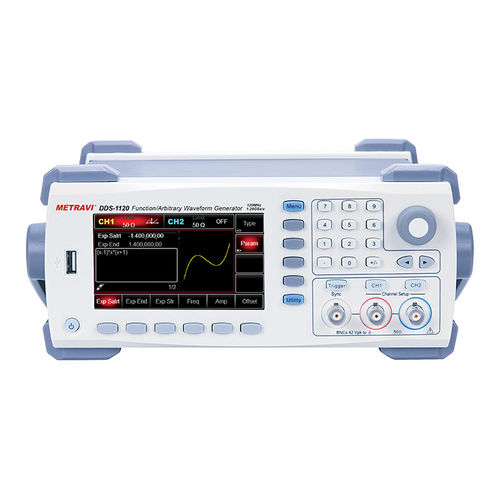
Tell us about your requirement

Price:
Quantity
Select Unit
- 50
- 100
- 200
- 250
- 500
- 1000+
Additional detail
Mobile number
Email

More Products in Digital Function Generator Category
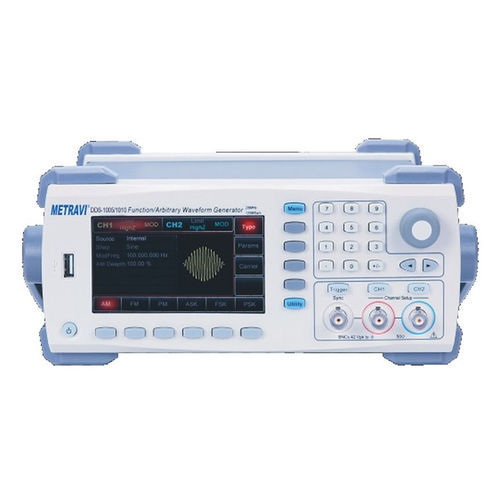
Metravi DDS-1010 DDS Function Generator
Price 22892.00 INR / Piece
Minimum Order Quantity : 1 Piece
Application : Signal generation for testing, education, and R&D
Frequency : 0.1 Hz 10 MHz
Equipment Type : Digital DDS Function Generator
Accuracy : 10 ppm
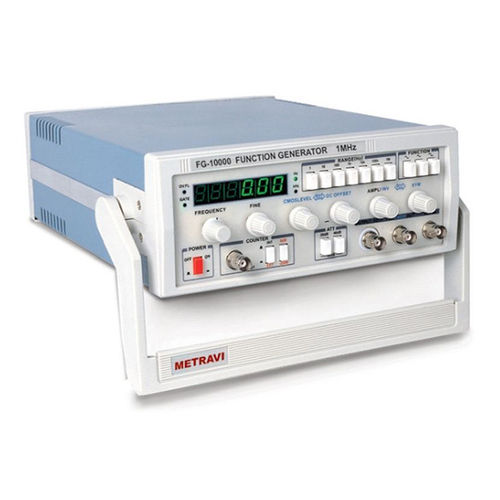
Metravi FG-10000 Digital Function Generator
Price 27317.00 INR / Piece
Minimum Order Quantity : 1 Piece
Application : Signal Generation, Electronics Testing, Laboratory Use
Frequency : 0.01 Hz to 10 MHz
Equipment Type : Digital Function Generator
Accuracy : 1%
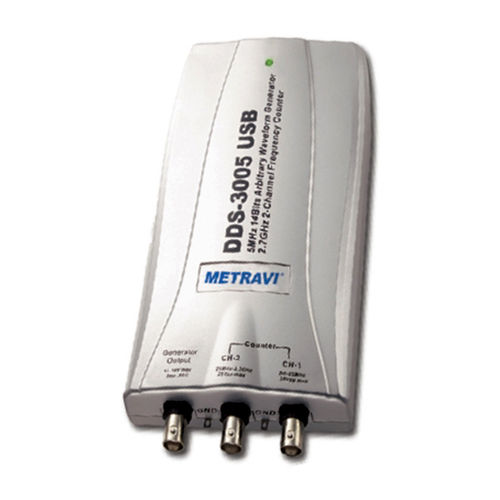
Metravi DDS-3005 PC Based Arbitrary Function Generator & Frequency Counter
Price 54457.00 INR / Piece
Minimum Order Quantity : 1 Piece
Application : Test Signal Generation, Educational Labs, R&D, Electronics Testing
Frequency : 5MHz (Output), Up to 50MHz (Counter)
Equipment Type : Arbitrary Function Generator & Frequency Counter
Accuracy : 10ppm
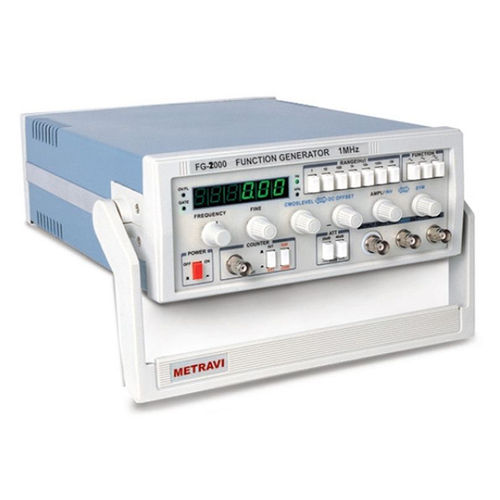
Metravi FG-2000 Digital Function Generator
Price 13747.00 INR / Piece
Minimum Order Quantity : 1 Piece
Application : Signal Generation, Testing, Lab and Industrial Use
Frequency : 0.2 Hz 2 MHz
Equipment Type : Digital Function Generator
Accuracy : 1% of range

Address
METRAVI INSTRUMENTS PVT. LTD.
GST : 19AAGCM1428H1ZH
GST : 19AAGCM1428H1ZH
- 32A, Ganesh Chandra Avenue, 4th Floor,Kolkata - 700013, West Bengal, India
- Phone :08071931506
- Send Inquiry
 Send Inquiry
 Send Inquiry
 Send SMS
 |
METRAVI INSTRUMENTS PVT. LTD.
All Rights Reserved.(Terms of Use) Developed and Managed by Infocom Network Private Limited. |
