 Call Us : 08071931506Call Us : 08071931506

 Send Inquiry
Metravi DSO-5100E Dual Channel Digital Storage Oscilloscope
Price 40297.00 INR/ Piece
MOQ : 1 Piece
Metravi DSO-5100E Dual Channel Digital Storage Oscilloscope Specification
- Display Type
- 7 inch, 800x480 pixels TFT-LCD
- Interface Type
- USB Host & Device
- Temperature
- 0C to 40C
- Frequency
- Bandwidth: 100 MHz
- Operating Voltage
- 100-240V AC
- Power Supply
- 100-240V AC, 50/60Hz
- Mounting Type
- Bench-Top
- Automation Grade
- Manual
- Response Time
- Real Time Sample Rate: up to 1GS/s
- Equipment Type
- Dual Channel Digital Storage Oscilloscope
- Measuring Range
- DC: 2mV/div - 10V/div; AC: 2mV/div - 10V/div
- Resolution
- 8 bits
- Accuracy
- 3% (Voltage), 50 ppm (Timebase)
- Humidity
- <85% RH
- Application
- Oscilloscope for electronic signal measurement and analysis
- Features
- Auto/Normal/Single Trigger, Math Functions, USB Storage, Cursor Measurement
- Usage
- Electronic Testing, Diagnostics, and Design
- Machine Weight
- 1.2 kg
- Control Mode
- Manual
- Memory Depth
- 40 Kpts
- Waveform Storage
- 50 waveforms
- Horizontal Time Base Range
- 2 ns/div to 100 s/div
- Vertical Sensitivity
- 2 mV/div to 10 V/div
- Trigger Modes
- Edge, Pulse, Video, Slope, Alternate
- Cursors
- Time, Voltage, Frequency
- Probe Attenuation
- 1X, 10X, and 100X
- Maximum Input Voltage
- 400V (PK - PK)
- Channels
- 2 (Dual Channel)
Metravi DSO-5100E Dual Channel Digital Storage Oscilloscope Trade Information
- Minimum Order Quantity
- 1 Piece
- Payment Terms
- Cash in Advance (CID), Cheque, Cash Advance (CA)
- Supply Ability
- Piece
About Metravi DSO-5100E Dual Channel Digital Storage Oscilloscope
- Double Analog Channels High-resolution colorful LCD display with resolution of 400 X 240 (or 800 X 480)
- To support plug and play USB storage instrument to communicate with computer.
- Automatic waveform and status setup. Waveform, setup, bitmap storage, waveform and setup reoccurrence.
- Elaborate view window extension function for delicate analysis of waveform details and profile
- Automatic measurement of 28 kinds of waveform parameters
- Automatic cursor tracing and measurement function
- Unique waveform recording and playback functions
- Embedded FFT
- Multiple mathematical calculation functions (including +, -, X, ) for waveform
- Edge, video, pulse width and ALT Trigger functions
- Multi-language menu display
- Bandwidth 100MHz
- Sampling Rage: 1GSA/Sec.
- Storage Depth: 25k
- Record Length: Sampling Point of 2 x 521k
- Vertical Deflection: 1mV/div~5V/div
Versatile Dual Channel Capability
The DSO-5100E features two channels, enabling simultaneous measurement and comparison of different signal sources. This versatility supports complex electronic analysis, from diagnostics to detailed circuit testing, enhancing productivity for engineers and technicians.
Advanced Signal Capture and Analysis
Offering a bandwidth of 100 MHz and a real-time sample rate of up to 1GS/s, this oscilloscope ensures precise capture of fast-changing electronic signals. Its 8-bit resolution and significant memory depth allow for detailed waveform inspection and comprehensive analysis.
User-Friendly Design
With a clear 7-inch TFT-LCD display and intuitive manual controls, the DSO-5100E prioritizes ease of use. Features like auto/normal/single trigger modes, cursor measurement, and USB storage simplify operation and speed up routine analysis tasks.
FAQ's of Metravi DSO-5100E Dual Channel Digital Storage Oscilloscope:
Q: How is the Metravi DSO-5100E Dual Channel Oscilloscope typically used in electronics testing?
A: This oscilloscope is primarily utilized for measuring, visualizing, and analyzing electronic signals in circuit diagnostics, design validation, and troubleshooting. Its dual channels allow for comparison and observation of multiple waveforms simultaneously.Q: What are the main benefits of using a digital storage oscilloscope like the DSO-5100E?
A: Digital storage oscilloscopes offer accurate waveform capture, the ability to store up to 50 waveforms, flexible triggering options, and intuitive interfaces. These enhance productivity and analysis capabilities, making them invaluable in both development and repair environments.Q: When should I use different probe attenuation settings (1X, 10X, 100X) with this oscilloscope?
A: Probe attenuation should be selected based on the signal amplitude and measurement requirements. Use 1X for low-voltage signals for maximum sensitivity, while 10X or 100X settings enable safe measurement of higher-voltage signals up to the 400V (PK-PK) input limit.Q: Where can the DSO-5100E be mounted or used for optimal operation?
A: Designed as a bench-top instrument, the DSO-5100E is best suited for use in labs, workshops, educational institutes, or electronic repair facilities with a stable power supply and a controlled environment within the 0C to 40C temperature range.Q: What process should I follow to store and retrieve waveforms using the USB interface?
A: To store waveforms, simply connect a USB storage device to the oscilloscope's USB port, select the desired waveform, and use the 'Save' function. To retrieve, access stored files via the USB menu, enabling quick recall for analysis or documentation.Q: How do the trigger modes (Edge, Pulse, Video, Slope, Alternate) improve waveform measurement?
A: These trigger modes allow users to capture specific events or anomalies in a signal. By more precisely controlling when acquisition starts, users can reliably isolate glitches or particular portions of a waveform for in-depth examination.Q: What is the measurement accuracy of the DSO-5100E, and why is it important?
A: The DSO-5100E delivers 3% voltage accuracy and 50 ppm timebase accuracy, ensuring that waveform measurements are both precise and reliable. This accuracy is crucial for dependable testing and diagnostics in both development and maintenance work.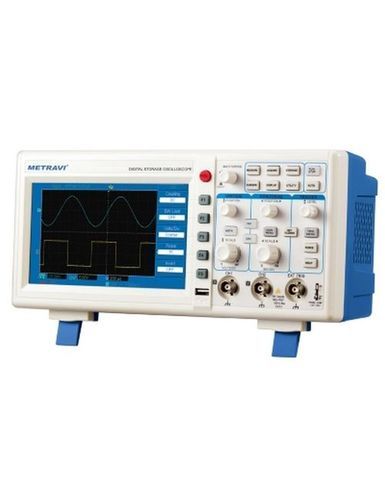
Tell us about your requirement

Price:
Quantity
Select Unit
- 50
- 100
- 200
- 250
- 500
- 1000+
Additional detail
Mobile number
Email

More Products in Oscilloscopes Category
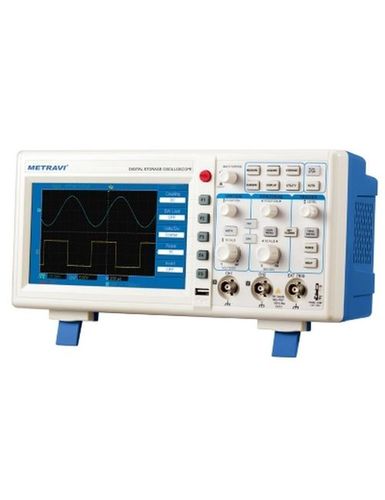
Metravi DSO-5070E Dual Input Digital Oscilloscope
Price 39117.00 INR / Piece
Minimum Order Quantity : 1 Piece
Interface Type : USB Host, USB Device
Display Type : 7inch TFT Color LCD (800x480 pixels)
Frequency : Bandwidth: 70 MHz
Operating Voltage : AC 100240V
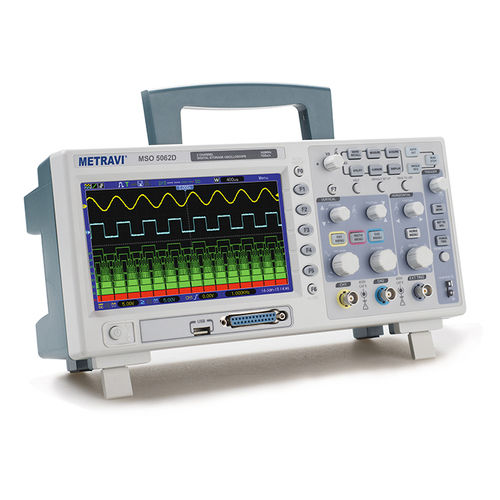
MSO-5062D Mixed Signal Oscilloscope
Price 75697.00 INR / Piece
Minimum Order Quantity : 1 Piece
Interface Type : USB 2.0, LAN, VGA, RS232
Display Type : 7inch TFT color LCD (800480)
Frequency : 60 MHz (analog); 1 GSa/s sampling rate
Operating Voltage : 100240V AC
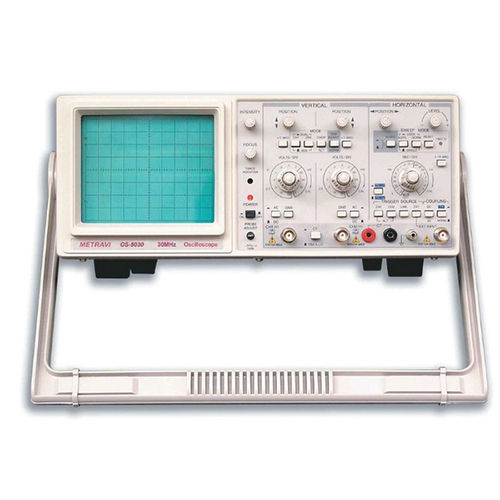
Metravi OS-5030 Dual Channel Oscilloscope
Price 33807.00 INR / Piece
Minimum Order Quantity : 1 Piece
Interface Type : BNC Input
Display Type : CRT Analog Display
Frequency : Bandwidth: 30 MHz
Operating Voltage : AC 220V 10%
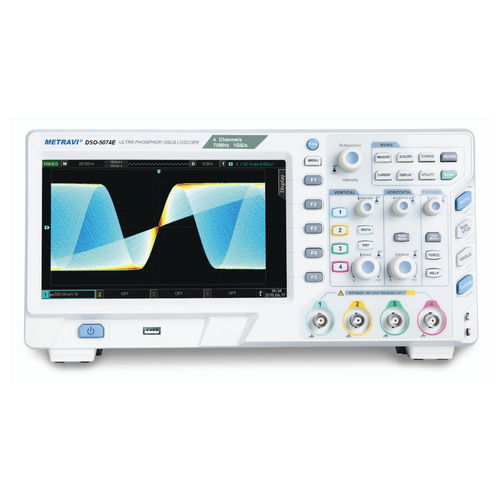
Metravi DSO-5074E Four Channel Phosphor Digital Storage Oscilloscope
Minimum Order Quantity : 1 Piece
Interface Type : USB Host, USB Device, LAN, Pass/Fail Out, Trigger Out
Display Type : 8inch 800480 pixels LCD display
Frequency : Bandwidth: 70 MHz; Sample Rate: up to 1GSa/s
Operating Voltage : 100240V AC

Address
METRAVI INSTRUMENTS PVT. LTD.
GST : 19AAGCM1428H1ZH
GST : 19AAGCM1428H1ZH
- 32A, Ganesh Chandra Avenue, 4th Floor,Kolkata - 700013, West Bengal, India
- Phone :08071931506
- Send Inquiry
 Send Inquiry
 Send Inquiry
 Send SMS
 Call Me Free
 |
METRAVI INSTRUMENTS PVT. LTD.
All Rights Reserved.(Terms of Use) Developed and Managed by Infocom Network Private Limited. |
