 Call Us : 08071931506Call Us : 08071931506

 Send Inquiry
Metravi OS-5100 Cathode Ray Oscilloscope
Price 82777.00 INR/ Piece
MOQ : 1 Piece
Metravi OS-5100 Cathode Ray Oscilloscope Specification
- Automation Grade
- Manual
- Accuracy
- 3%
- Application
- Measurement & Display of Electrical Signals
- Features
- Portable, 50 MHz Bandwidth, Dual Channel
- Display Type
- CRT
- Mounting Type
- Bench
- Response Time
- Instantaneous
- Operating Voltage
- 230V AC
- Humidity
- Up to 80% (non-condensing)
- Interface Type
- Analog
- Measuring Range
- DC & AC Voltage
- Power Supply
- 230V AC 10%, 50 Hz
- Temperature
- 0C to 50C
- Frequency
- Up to 50 MHz
- Usage
- Laboratory / Education / Electronic Testing
- Machine Weight
- Approx. 8.1 kg
- Control Mode
- Manual
- Fuse Rating
- 0.5A / 1A
- Equipment Type
- Cathode Ray Oscilloscope
- Line Voltage Range
- 198V to 242V AC
- Time Base Range
- 0.2 s/div to 0.5 s/div
- Trigger Modes
- Auto, Normal, TV-H, TV-V
- Color
- Grey/Off White
- CRT Screen Size
- 100 mm (approx)
- Safety Standard
- Meets IS/IEC standard
- Dimensions
- 355 mm x 170 mm x 370 mm
- Bandwidth
- 50 MHz
- Vertical Sensitivity
- 2 mV/div to 10 V/div
- Synchronization
- Internal & External
- Input Impedance
- 1 M / 30 pF
- Input Channels
- 2 (Dual Channel)
- Horizontal Sweep
- 0.2 s/div to 0.5 s/div
Metravi OS-5100 Cathode Ray Oscilloscope Trade Information
- Minimum Order Quantity
- 1 Piece
- Payment Terms
- Cash Advance (CA), Cash in Advance (CID), Cheque
About Metravi OS-5100 Cathode Ray Oscilloscope
- Dual Channel Four Trace OscilloscopeBandwidth: 100MHzConfirms to EN61010-1 (1993) and EN-IEC61326-1(1997)It has the function of B delay sweepHigh sensitivity: 1mV/DIV
- In ALT (A and B alternately sweeps) mode, four traces are displayed
- Fast sweep rate to 5ns/DIV by magnifying 10
- The function of B TRIGD can decrease the delay shrinking
- The hold-off function makes it easier to catch the complex triggering signals
- Vertical deflection sensitivity: 5mV/Div to 5V/Div in 1-2- 5 sequence in 10 steps
- Accuracy: 5%
- Rise Time: 3.5nS
- Maximum Input Voltage : 400V (DC + AC peak)
- Operating Systems: CH1, CH2, ADD, DUAL (CHOP, ALT)
- Trigger mode: AUTO, NORM, TV-V, TV-H
- Trigger signal source: INT, CH2, LINE, EXT
- External trigger input: About 1m.Ohms 25pF impedance
- Z-axis maximum input: 30V (DC+AC peak) voltage
- Bandwidth: DC to 2MHz
- Sweep Mode : A,B, B Triggered, X-Y, ALT
- Sweep time :
- A: 0.05uS to 0.2S/Div 5% in 21 calibrated steps (1-2-5 seq)
- B: 0.05uS to 10uS/Div 5% in 8 calibrated steps (1-2-5 seq)
Delay system : Continuous delay or triggered delay
- Hold-off: Continuous change for 2 times
- X-Y Operation mode : CH1 X-axis and CH2 Y-axis
- Calibration Signal : 0.5V Square wave of 1kHz
- Auxiliary Power Supply : 230V 50Hz AC
Accurate Signal Measurement
With its 50 MHz bandwidth and vertical sensitivity starting at 2 mV/div, the OS-5100 captures both low- and high-frequency signals with 3% accuracy. Its dual-channel input and versatile synchronization options, including internal and external sources, make it suitable for complex analysis in professional and educational settings.
Robust Design and Safety Features
The Metravi OS-5100 is housed in a durable enclosure, colored grey/off white, and built to comply with IS/IEC safety standards. It features a fuse rating of 0.5A/1A and operates safely within a line voltage range of 198V-242V AC, making it dependable across multiple environments, with a weight of just 8.1 kg for easy portability.
FAQ's of Metravi OS-5100 Cathode Ray Oscilloscope:
Q: How do I set up and operate the Metravi OS-5100 Cathode Ray Oscilloscope?
A: To set up the oscilloscope, place it on a stable bench and connect it to 230V AC supply. Then, adjust the control knobs manually to select your desired vertical sensitivity, horizontal sweep, and synchronization mode before connecting your test signal to one of the dual input channels.Q: What types of electrical signals can the OS-5100 display and measure?
A: This oscilloscope is designed to accurately measure and display both DC and AC voltages across a frequency range up to 50 MHz. It handles signals with a high degree of precision, making it ideal for laboratory, educational, and electronic testing applications.Q: When should I use the different trigger modes available on this oscilloscope?
A: You can use the Auto trigger for continuous signal capture, Normal mode for triggered events, and TV-H/TV-V for analyzing horizontal and vertical synchronization of TV signals. Selection depends on the nature and timing of the signal you are examining.Q: Where is the Metravi OS-5100 best utilized?
A: The OS-5100 is suitable for laboratory benches, educational settings, and electronic testing stations. Its compact size and portable design allow you to use it wherever precise analog signal measurement and visualization are required.Q: What is the process for measuring a signal using this oscilloscope?
A: To measure a signal, connect the probe to the channel input and adjust the vertical and horizontal controls for optimal display. Use the manual control mode to fine-tune settings and select the appropriate trigger for stable waveform visualization.Q: How does the oscilloscope benefit users in testing and educational environments?
A: Its instantaneous CRT display response, dual-channel inputs, and multiple synchronization options enable users to analyze complex electrical signals quickly and accurately. The robust safety standards, portability, and wide measuring range support efficient and safe operation in diverse settings.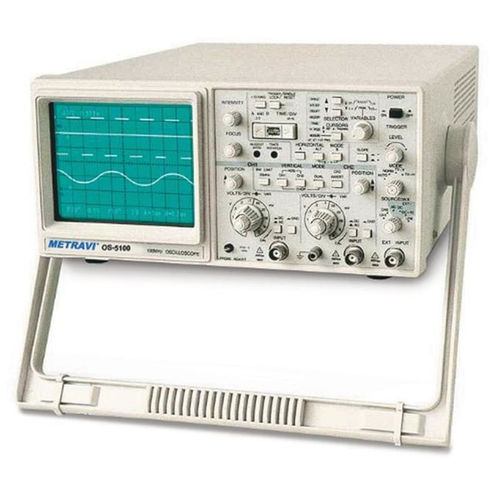
Tell us about your requirement

Price:
Quantity
Select Unit
- 50
- 100
- 200
- 250
- 500
- 1000+
Additional detail
Mobile number
Email

More Products in Oscilloscopes Category
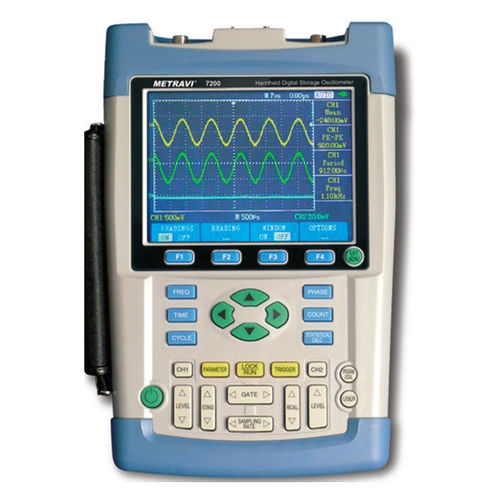
Metravi 7200 Oscillometer
Price 389577.00 INR / Piece
Minimum Order Quantity : 1 Piece
Application : Determines natural frequency & damping ratio of moving system
Accuracy : 0.1 mm
Control Mode : Manual
Measuring Range : 020 mm amplitude
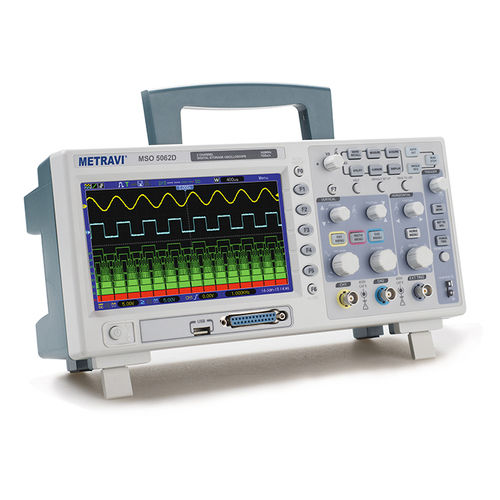
MSO-5062D Mixed Signal Oscilloscope
Price 75697.00 INR / Piece
Minimum Order Quantity : 1 Piece
Application : Electronic signal measurement and analysis
Accuracy : (3% reading + 0.1 div)
Control Mode : Manual / Auto
Measuring Range : DC to 60 MHz
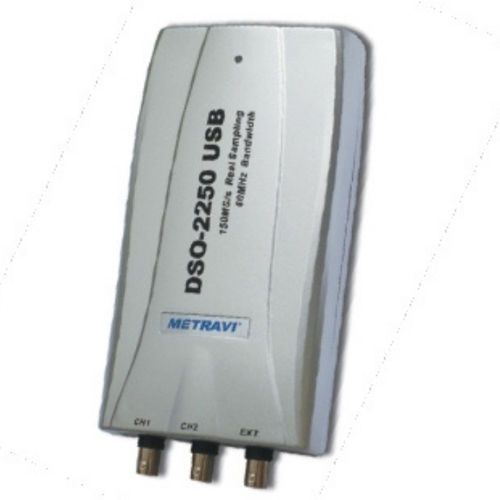
Metravi DSO-2250 PC-based Digital Storage Dual Channel Oscilloscope
Price 46197.00 INR / Piece
Minimum Order Quantity : 1 Piece
Application : Electronic diagnostics, waveform analysis, servicing, lab usage
Accuracy : 3% (Vertical) @ 25C
Control Mode : PCBased via USB Interface
Measuring Range : DC: 5 mV/div to 5 V/div
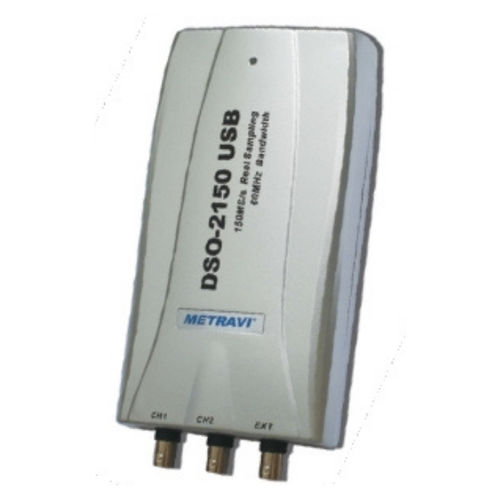
Metravi DSO-2150 PC-based Digital Storage Dual Channel Oscilloscope
Price 35577.00 INR / Piece
Minimum Order Quantity : 1 Piece
Application : Electronic Diagnostics, Signal Analysis
Accuracy : 3%
Control Mode : PC Control via USB
Measuring Range : Vertical: 5mV/div to 5V/div

Address
METRAVI INSTRUMENTS PVT. LTD.
GST : 19AAGCM1428H1ZH
GST : 19AAGCM1428H1ZH
- 32A, Ganesh Chandra Avenue, 4th Floor,Kolkata - 700013, West Bengal, India
- Phone :08071931506
- Send Inquiry
 Send Inquiry
 Send Inquiry
 Send SMS
 |
METRAVI INSTRUMENTS PVT. LTD.
All Rights Reserved.(Terms of Use) Developed and Managed by Infocom Network Private Limited. |
