 Call Us : 08071931506Call Us : 08071931506

 Send Inquiry
Metravi DSO-5050E Dual Channel Digital Storage Oscilloscope
Price 230000.00 INR/ Piece
MOQ : 1 Piece
Metravi DSO-5050E Dual Channel Digital Storage Oscilloscope Specification
- Features
- Auto measurement, cursor measurement, 32 parameters, math functions, USB storage, printing, waveform recording
- Frequency
- Bandwidth: 50 MHz
- Measuring Range
- Vertical: 2mV/div~5V/div (x1 probe); Time base: 5ns/div~50s/div
- Mounting Type
- Bench-top
- Accuracy
- 3% (vertical)
- Resolution
- 8 bit (vertical)
- Interface Type
- USB Host & Device
- Automation Grade
- Semi-automatic
- Temperature
- 0 to 40C
- Humidity
- 85% RH (non-condensing)
- Operating Voltage
- 100-240V AC
- Equipment Type
- Dual Channel Digital Storage Oscilloscope
- Power Supply
- 100-240V AC, 50/60Hz
- Display Type
- 7-inch Color TFT LCD
- Application
- Electronic and electrical signal analysis, waveform observation, troubleshooting
- Usage
- Laboratory, R&D, Education, Service & Maintenance
- Machine Weight
- Approx. 2.5 kg
- Control Mode
- Manual/Auto
- Memory Depth
- 16 kpts
- Input Impedance
- 1 M 2%, 20 pF 3 pF
- Power Consumption
- < 18W
- Number of Channels
- 2 (Dual Channel)
- Languages Supported
- English, Chinese
- Waveform Capture Rate
- up to 25,000 wfms/s
- USB Storage Support
- Yes
- Sample Rate
- Real Time: up to 500 MSa/s
- Trigger Modes
- Edge, Pulse, Video, Slope, Alternate
- Display Resolution
- 800 x 480 pixels
- Record Length
- up to 16 kpts
- Waveform Math Functions
- Add, Subtract, Multiply, FFT
- Safety Category
- CAT I (Mains)
- Dimensions (WxHxD)
- 310 x 150 x 70 mm
Metravi DSO-5050E Dual Channel Digital Storage Oscilloscope Trade Information
- Minimum Order Quantity
- 1 Piece
- Payment Terms
- Cash Advance (CA), Cash in Advance (CID), Cheque
- Supply Ability
- Piece
About Metravi DSO-5050E Dual Channel Digital Storage Oscilloscope
- Double Analog Channels High-resolution colorful LCD display with resolution of 400 X 240 (or 800 X 480)
- To support plug and play USB storage instrument to communicate with computer.
- Automatic waveform and status setup. Waveform, setup, bitmap storage, waveform and setup reoccurrence.
- Elaborate view window extension function for delicate analysis of waveform details and profile
- Automatic measurement of 28 kinds of waveform parameters
- Automatic cursor tracing and measurement function
- Unique waveform recording and playback functions
- Embedded FFT
- Multiple mathematical calculation functions (including +, -, X, ) for waveform
- Edge, video, pulse width and ALT Trigger functions
- Multi-language menu display
- Bandwidth 50MHz
- Sampling Rage: 500MSA/Sec.
- Storage Depth: 25k
- Record Length: Sampling Point of 2 x 521k
- Vertical Deflection: 1mV/div~5V/div
Efficient Waveform Analysis
Easily capture, view, and analyze complex electronic signals with the DSO-5050E's dual channels and wide measuring range. Waveform math functions such as addition, subtraction, multiplication, and FFT allow for precise signal processing and analysis for development and troubleshooting tasks.
Advanced Triggering Capabilities
The oscilloscope includes diverse trigger modes-edge, pulse, video, slope, alternate-that help isolate specific signal events. This ensures you can detect and respond to anomalies with speed and accuracy, whether in laboratory experiments or electrical maintenance.
Intuitive Operation and Storage
Features like auto measurement, cursor measurement, 32 parameters, and semi-automatic control provide intuitive operation. USB host/device interfaces support easy data storage and printing, streamlining workflow for technical professionals and educators.
FAQ's of Metravi DSO-5050E Dual Channel Digital Storage Oscilloscope:
Q: How do I use the DSO-5050E Digital Storage Oscilloscope for electronic signal analysis?
A: To analyze electronic signals, connect your test probes to the oscilloscope's input channels. Select the appropriate vertical and time base settings, and use the auto or manual modes for capturing and displaying waveforms. Utilize the math functions and measurement features for thorough signal diagnostics.Q: What are the benefits of the dual channel functionality in this oscilloscope?
A: The dual channel capability enables simultaneous observation of two different signals, making it easier to compare waveforms, diagnose circuit behavior, and troubleshoot complex electronic systems in real time.Q: When should I use the various trigger modes available on the DSO-5050E?
A: You should select trigger modes based on your application: use edge or pulse triggers to capture specific signal changes, slope or alternate for waveform transitions, and video for detailed video signal analysis. These modes help isolate and examine critical signal events during testing.Q: Where can the DSO-5050E be effectively used?
A: This oscilloscope suits laboratory settings, research and development, educational institutions, and service & maintenance workshops. Its bench-top design, precise measurement ranges, and safety standards make it ideal for professional environments across India.Q: How does USB storage support enhance workflow with the DSO-5050E?
A: The USB host and device interfaces allow you to save waveforms, export measurement data, or print results directly. This simplifies documentation and sharing of findings, making it convenient for analysis, reporting, and educational demonstrations.Q: What process should I follow to ensure accurate measurements with the DSO-5050E?
A: Ensure proper probe calibration and connection, select correct measurement parameters, and use the device's auto measurement and cursor functions. The 3% vertical accuracy, 8-bit resolution, and 7-inch TFT LCD provide reliable and clear results for every analysis session.Q: What is the typical application of the DSO-5050E Dual Channel Oscilloscope?
A: Typical applications include electronic and electrical signal testing, waveform observation, troubleshooting circuits, and analyzing system behavior in laboratories, R&D units, educational labs, and service centers.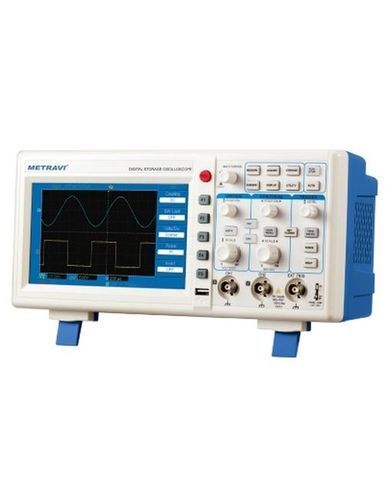
Tell us about your requirement

Price:
Quantity
Select Unit
- 50
- 100
- 200
- 250
- 500
- 1000+
Additional detail
Mobile number
Email

More Products in Oscilloscopes Category
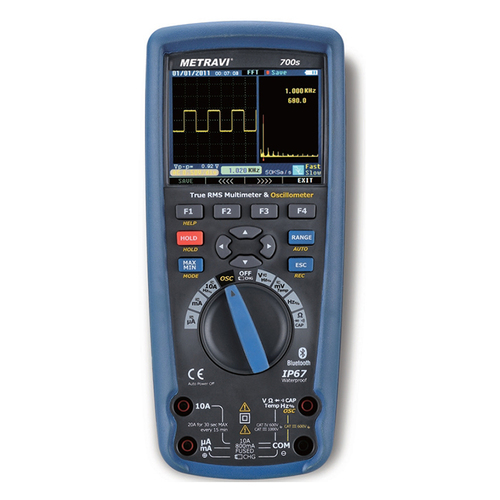
Metravi 700S Industrial Multimeter with built-in Oscillometer
Price 68,617.00 INR / Piece
Minimum Order Quantity : 1 Piece
Application : Industrial Electrical Measurements, Fault Diagnostics, Oscilloscope Functions
Automation Grade : Manual & SemiAutomatic with Autoranging
Resolution : Display: 1mV/0.1A/0.1 (Depending on Range)
Interface Type : USB for PC Communication
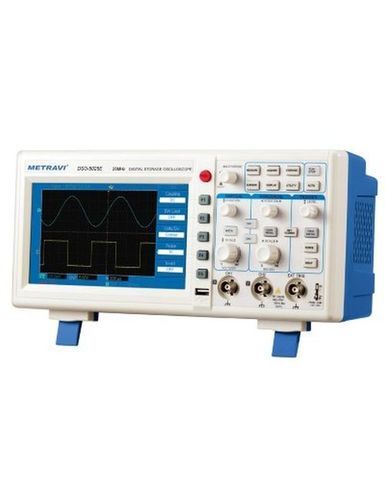
Metravi DSO-5025E Dual Channel Digital Storage Oscilloscope
Price 29677.00 INR / Piece
Minimum Order Quantity : 1 Piece
Application : Electronic Signal Measurement and Analysis
Automation Grade : Manual with Software Assistance
Resolution : 8bit
Interface Type : USB 2.0
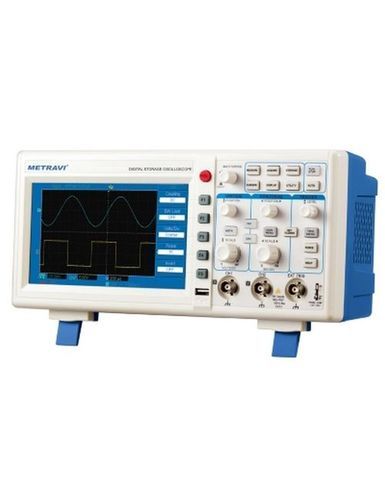
Metravi DSO-5100E Dual Channel Digital Storage Oscilloscope
Price 40297.00 INR / Piece
Minimum Order Quantity : 1 Piece
Application : Oscilloscope for electronic signal measurement and analysis
Automation Grade : Manual
Resolution : 8 bits
Interface Type : USB Host & Device
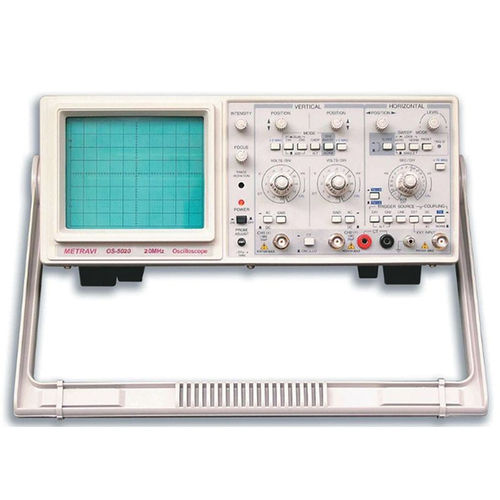
Metravi OS-5020 Dual Channel Oscilloscope
Price 31447.00 INR / Piece
Minimum Order Quantity : 1 Piece
Application : Electronic signal monitoring, waveform analysis, laboratory, and field testing
Automation Grade : Manual
Resolution : 0.2 mV
Interface Type : BNC Input for probes

Address
METRAVI INSTRUMENTS PVT. LTD.
GST : 19AAGCM1428H1ZH
GST : 19AAGCM1428H1ZH
- 32A, Ganesh Chandra Avenue, 4th Floor,Kolkata - 700013, West Bengal, India
- Phone :08071931506
- Send Inquiry
 Send Inquiry
 Send Inquiry
 Send SMS
 |
METRAVI INSTRUMENTS PVT. LTD.
All Rights Reserved.(Terms of Use) Developed and Managed by Infocom Network Private Limited. |
